Sea level
By Jenny Hynes
My calves were convulsing on the couch Monday morning.
I already knew I wasn’t going to make it to work.
I could barely walk. My throat hurts. My chest felt tight. The kind of tightness that arrives at the end of May when you work in special education and have spent months carrying too many nervous systems at once.
It felt like I might cry.
Not dramatic crying. Not cinematic crying.
Just that strange wave that suddenly rises in your chest when your body quietly admits it is exhausted.
I felt this kind of sadness during Fiona’s kindergarten year during the pandemic, when I was drafting desperate emails to teachers, administrators, advocates, lawyers. I understand the system from both sides now. That’s part of why this work can feel so physically heavy by spring.
I decided to stay home.
Sea level again.
And everything lately feels slightly underprepared.
Slightly too soft for the terrain.
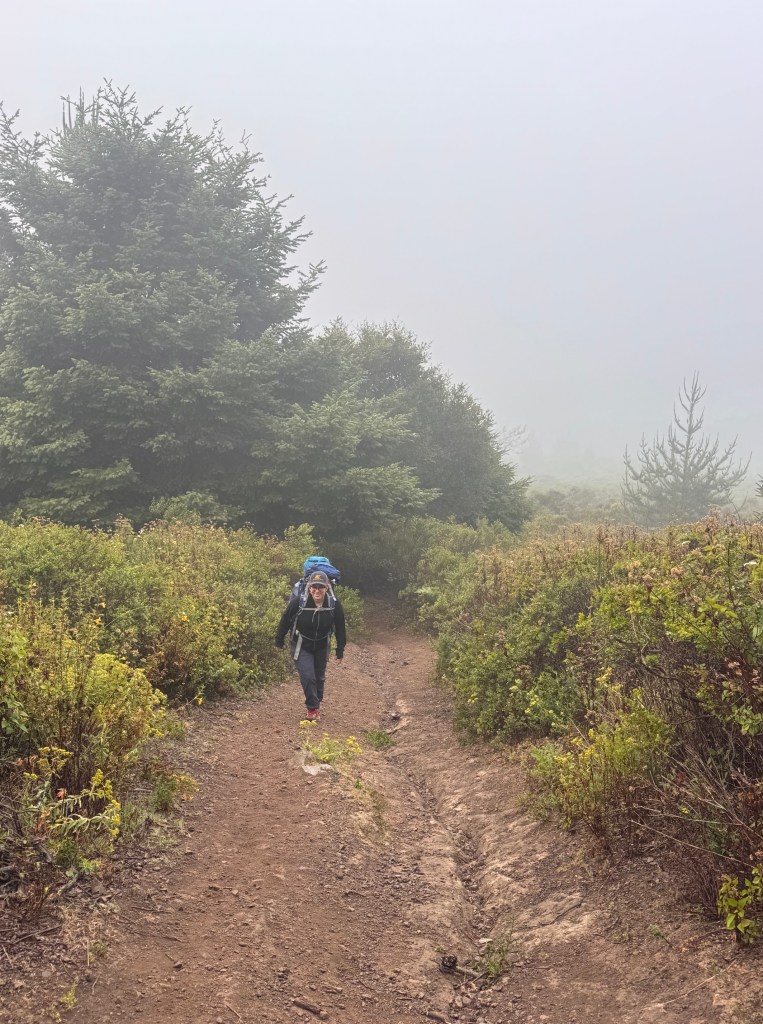
The day before, I had spent hours climbing through fog above Stinson Beach carrying a twenty-pound pack.
Fifteen hundred feet of relentless ascent.
Wet grass. Loose rock. Wind.
Every time I thought I had reached the top, another dirt shadow appeared through the mist. Another climb slowly revealing itself.
One foot in front of the other.
One foot in front of the other.
At first, I felt strong.
My clothes were dry. My boots felt sturdy. I kept thinking I had finally worn the correct layers, bought the correct gear, trained correctly.
Then the mountain shifted.
We entered a forest of pine trees, ferns, and a soft path, not as slippery as the grassy hill.
Mist sprayed sideways through the trees until my clothes soaked through completely. My merino wool base layers clung to my skin like wet animal hide. My leather boots slowly filled with water.
By the descent, my legs were shaking too hard to comfortably bend down and retie my laces.
The trail was steep, muddy, poison-oaky, and strangely beautiful.
I hated that mountain for at least half the hike.
Screaming. Panting. Slipping. Grunting. Spitting sweat into the fog.
I kept going.
I was not going to turn back.
The Pacific rumbled somewhere below us the entire time, hidden behind walls of moving fog. I kept thinking eventually the trail would flatten out beside some cinematic ocean overlook.
It never did.
Instead, there were giant banana slugs, thorny thistles grabbing at my socks, and a sign at the edge of one muddy section that read:
NOT A MAINTAINED TRAIL.
USE AT YOUR OWN RISK.
Which honestly felt like a fitting metaphor for my current state of existence.
When I got home that night, I unloaded all my gear into the garage.
Wet sleeping bag.
Wet backpack.
Wet boots still stretched out from the hike.
The guy at REI had warned me that mold destroys camping gear, so I hung everything carefully to dry and immediately started rereading the itinerary for my mountaineering trip.
Excellent physical condition.
12–14-mile hikes.
5000 feet elevation gain.
Steep off-trail terrain.
I reread the supply list and suddenly realized I had misunderstood the boot requirement entirely.
Not leather hiking boots.
Stiff hiking boots.
Light mountaineering boots.
Real alpine boots.
The kind that sound serious even sitting in a sentence.
I immediately panic-bought a new pair from the REI sale.
Because after spending three miles sloshing downhill in wet leather boots at sea level, I could suddenly imagine exactly what would happen on snow.
Frozen socks.
Frozen feet.
Frostbite.
I spiraled.
And yet, somewhere underneath the panic was another realization:
I am becoming someone who trains anyway.
Not in ideal conditions.
Not in peaceful mountain monasteries.
In ordinary life.
In crowded parking lots after work.
In early morning Orangetheory classes.
In exhaustion.
In grocery store lines.
In the space between difficult meetings and making dinner.
Last August I started waking up at 4:30 in the morning so nothing could interfere with training.
The year before, I always tried going to the gym after work, but meetings, stress, parenting, and emotional exhaustion kept swallowing the plan whole.
So, I changed the system.
Three or four mornings a week since August, I have gotten up before sunrise and gone anyway.
My husband told me at first he didn’t think I could do it.
Honestly, neither did I.
But somewhere along the way my body started changing.
Not dramatically.
Not all at once.
Measured adaptation.
The same kind I spend all year tracking in students.
Progress monitoring.
Data collection.
Incremental growth.
Repeated intervention.
Confidence, I’m realizing, is often just accumulated evidence.
Evidence that you returned.
Evidence that you trained.
Evidence that you kept showing up.
At the climbing gym this week, I made it farther than I ever have on the 5.11 auto belay.
I’m past the crux now.
There’s only one section left near the top where my arms start shaking and my brain begins insisting I am too high, too tired, too weak.
But I know the rope is holding me.
I know I’m safe.
And still, I’m scared of falling.
On Wednesday I’m going back.
And this time I’m getting to the top.
I don’t care how many attempts it takes.
My legs will shake. My forearms will feel like they can’t understand what my brain is asking them to do.
My skin sore from the holds.
I’ll count the same way I counted on the mountain:
1-2-3-4.
1-2-3-4.
One movement at a time.
And maybe:
So is conflict.
So is disappointment.
So is not pleasing everyone.
The strange thing about hard days is that they keep becoming other days.
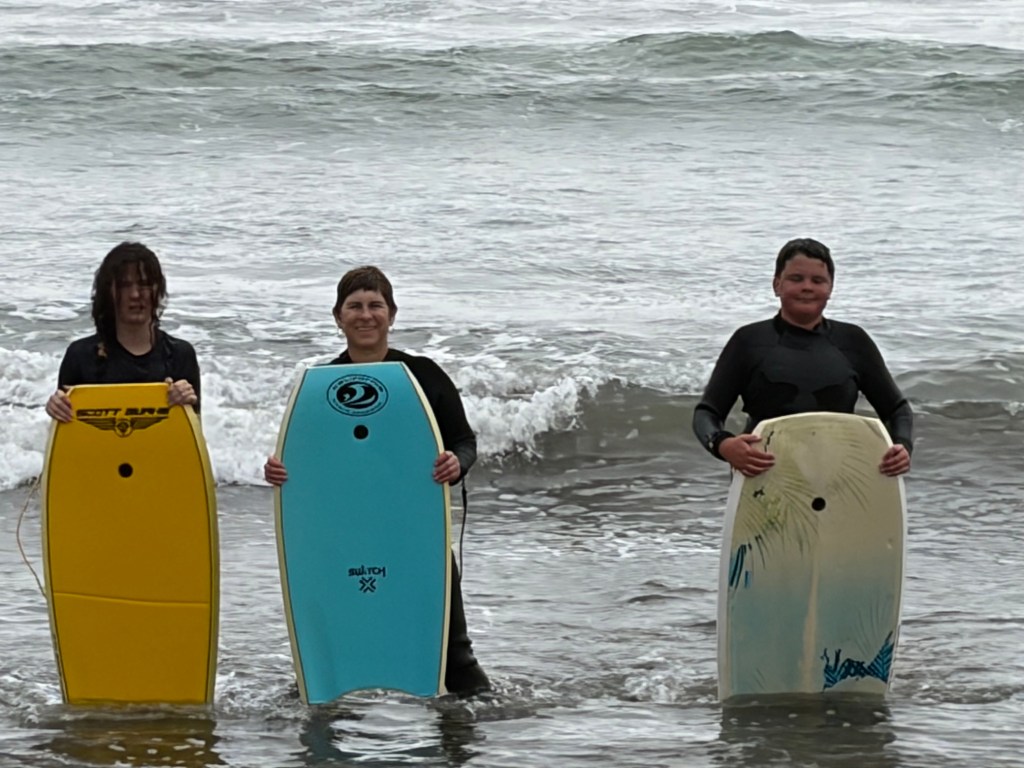
Later that afternoon, Sunday, the same day as the hike, the kids and I rented wetsuits and boogie boards and stayed in the freezing Pacific for hours.
I had warned the kids earlier that I may be too tired, but when I saw the waves, I could not resist.
The freezing water soothed my legs and feet, the churn of the ocean felt like a whirlpool.
Cold. Salty. Violent.
Perfect.
The waves knocked us around for hours.
Fiona and I used ASL out in the water while the kids screamed every time the waves crashed over us and filled our ears and mouths with salt.
I felt like a sea creature.
Like something old in me was waking back up.
At one point my son looked calmly at my face and said:
“Mom… your nose.”
Blood was pouring onto the sand.
For one brief second, I thought:
Oh good. Sharks.
I rinsed my face repeatedly in the freezing water while the Pacific kept pulling at my legs.
My chest still hurts today.
My throat hurts.
I’m getting sick.
And somehow, I still want to go back out.
That’s the part I’m trying to understand about myself lately.
Not toughness exactly.
But this strange willingness to keep entering difficult landscapes even when I know they will expose every weakness I have.
The mountain exposed my conditioning.
The ocean exposed my body.
Life lately has exposed the limits of my emotional endurance.
And still, underneath all of it, I feel myself becoming more capable.
Not stronger in the cinematic way.
Stronger in the animal way.
The kind of strength that breathes slower.
Adjusts the pack.
Buys the correct boots.
Keeps climbing anyway.